
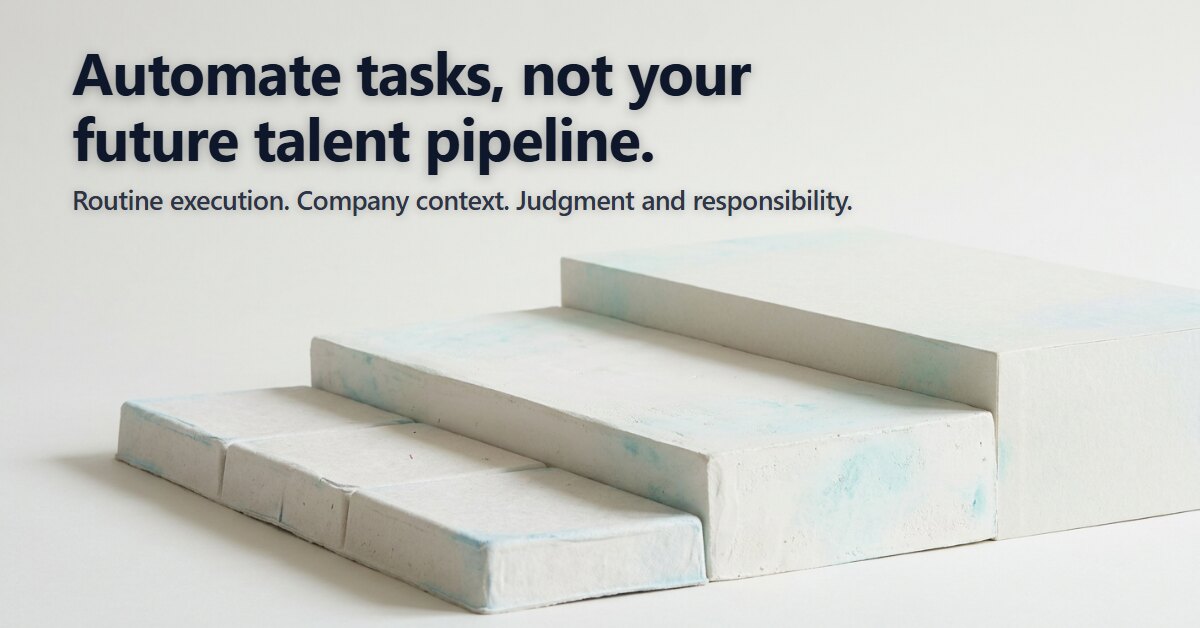
Yes. Hiring junior employees still makes sense when the role helps them learn how your company works, develop sound judgment and take on greater responsibility.
AI can accelerate routine tasks, but automating part of a job does not automatically remove the need for the role. The practical question is whether useful work and a credible path for development remain after suitable tasks have been automated.
Automating tasks does not automatically remove the role
A job combines tasks, decisions, relationships and responsibility. AI may change some of these elements without taking over the whole role.
An AI tool can prepare a draft, categorise incoming requests, summarise documents or identify missing information. That does not mean it should approve a customer exception, interpret why a process has failed or take responsibility for the result.
Review the role after suitable tasks have been automated. If valuable work remains and the employee can progress towards more difficult decisions, the role still has a purpose.
If the remaining work consists only of copying information, following fixed instructions and checking drafts without understanding them, do not preserve the role unchanged. Redesign it or reconsider whether you need it.
Build junior roles in three layers
A useful junior role usually contains three layers:
- Routine execution. The employee follows clear rules, checks inputs and completes repeatable steps. AI can often accelerate this work.
- Company context. The employee learns how customers behave, where processes fail, which exceptions matter and how teams depend on one another.
- Judgment and responsibility. The employee starts making decisions, explaining recommendations and taking ownership within defined limits.
Routine work should be an entry point, not the destination. It can still have learning value when it exposes an employee to real customer requests, operational data and the consequences of errors.
For example, reviewing customer requests may look repetitive. It can also teach a junior employee how customers describe problems, what information is usually missing and where standard procedures do not fit. Once the employee recognises these patterns, AI can handle more of the initial sorting while the employee focuses on exceptions.
A repetitive task with no useful context and no connection to harder work is a stronger candidate for automation.
Audit the role before deciding whether to hire
Review each junior role using three questions:
- What can you automate safely? Look for repeatable tasks with clear inputs, predictable outputs and a reliable way to check the result.
- What teaches company context? Keep or redesign work that helps the employee understand customers, processes, data, exceptions and downstream effects.
- Which decisions can the employee gradually take over? Identify limited decisions that can move from observation to supervised practice and then to independent ownership.
A simple classification can help:
| Type of work | Recommended treatment |
|---|---|
| Repetitive with little learning value | Automate where practical |
| Repetitive but useful for learning | Keep selectively, then reduce over time |
| Variable and low risk | Assign to the junior with review |
| Variable and high risk | Use approval rules and close supervision |
Do not assess automation only by whether a tool can produce an output. Ask who will verify it, what happens when it is wrong and whether checking it requires the expertise you were trying to avoid hiring.
Redesign work around exceptions and decisions
Consider a junior operations coordinator who sorts customer requests, enters information into internal systems, prepares standard replies and escalates unusual cases.
A weak redesign would automate most of the work and leave the employee checking AI-generated text all day. The role would remain busy but offer little development.
A stronger design would divide the work differently:
- AI categorises requests and prepares draft replies.
- The junior checks the source information, category and proposed response.
- The junior records why a draft must change when an exception appears.
- A manager reviews selected cases and explains the decision criteria.
- The junior gradually takes ownership of defined types of exceptions.
- Recurring exceptions are used to improve processes and automation rules.
Responsibility can then increase through four stages:
- Follow clear rules. Learn the process and the standard for correct work.
- Handle recognised exceptions. Choose from approved responses when the standard process does not fit.
- Recommend an action. Analyse an unfamiliar case and explain the reasoning before a manager approves it.
- Decide within agreed limits. Own defined decisions and escalate cases that exceed set levels of risk, cost or uncertainty.
Those limits should be specific. A junior might approve a standard customer correction but need approval for a refund, contractual exception or change affecting several teams.
AI can retrieve information, prepare options and check consistency at each stage. You still need to define who may make each decision and who remains accountable.
Confirm that you can support the role
A junior role is unlikely to work well if nobody has time to review work, explain decisions or increase the difficulty of assignments.
Before opening the position, confirm that you can provide:
- an experienced person responsible for the employee's development;
- clear standards for acceptable work;
- regular feedback based on real cases;
- access to relevant customer and operational context;
- progressively harder decisions;
- clear escalation rules.
If these conditions are missing, AI is not the main problem. The company lacks the management capacity required for an entry-level role.
Also consider where experienced employees will come from later. External hires can fill specialist and management positions, but they will still need to learn your customers, processes and unwritten rules. Stopping junior recruitment may reduce training needs now, but it also removes one route for developing company knowledge internally.
Do not hire a junior simply to preserve a traditional career ladder. Hire when useful work remains after automation, the role teaches company context and you can offer a clear path towards harder decisions.
Frequently asked questions
Which junior tasks should you automate first?
Start with repetitive tasks that have clear inputs, predictable outputs and little learning value. Examples include basic categorisation, formatting, initial document summaries and standard draft preparation.
Keep human review where errors could affect customers, money, legal obligations or important internal decisions. Decide in advance how outputs will be checked and who will handle exceptions.
Should junior employees be allowed to use AI at work?
Yes, if you define acceptable uses, verification requirements and escalation rules. Employees should understand the source material and be able to explain the final output rather than submitting work they cannot assess.
The controls should match the risk. Preparing an internal first draft requires less oversight than recommending a customer refund or interpreting a contractual requirement.
Can simple tasks still support junior development?
Yes. A simple task can reveal how customer requests differ, how information moves through the company or what happens when an error occurs.
It becomes a poor use of time when it remains repetitive, teaches nothing new and provides no route to harder work. At that point, automate it where practical or remove it from the role.
How can you tell whether a junior role is designed well?
The role should have a clear starting point, regular feedback and visible progression towards more difficult decisions. After suitable routine work is automated, the employee should still be able to learn company context, handle exceptions and take ownership within defined limits.
If you cannot identify what the employee will learn, which decisions they may eventually own and who will help them progress, redesign the role before hiring.